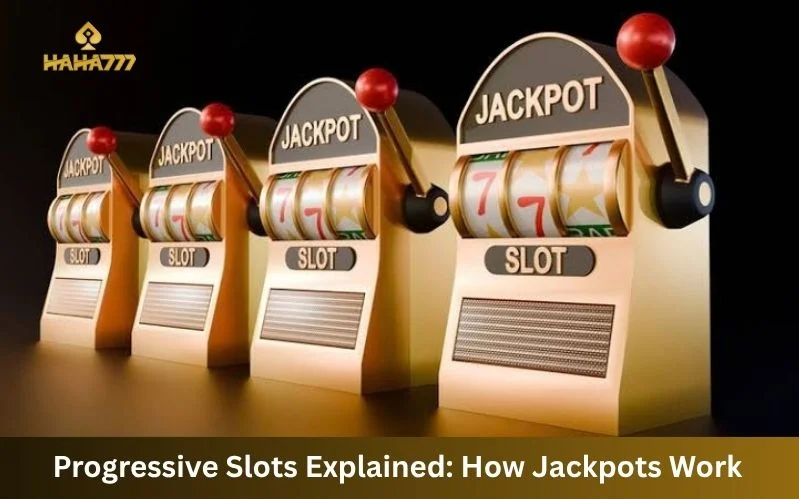
Progressive slots are online slot games with jackpots that can increase over time instead of staying at one fixed amount. In many games, qualifying wagers contribute to a jackpot pool. The prize keeps growing until the jackpot condition is triggered, after which it usually returns to a predetermined starting value known as the seed amount.
Progressive jackpot slots can use different structures. Some are attached to one game, others link several games, and larger networks can combine qualifying play across participating platforms. Players exploring progressive slots on Haha777 may therefore see different jackpot structures, eligibility rules, and payout conditions depending on the individual game.
What Are Progressive Slots?
A progressive slot is a slot game in which the jackpot can rise as eligible play continues. Unlike a fixed-prize slot, where the top award is predetermined, a progressive jackpot may keep increasing until someone triggers it.
The current amount is normally shown on a jackpot meter. Depending on the design, part of each qualifying wager may feed the progressive pool. This does not mean every wager contributes in every game; the funding rules vary.
Regular slot wins and the progressive jackpot are also separate concepts. Players may receive normal payouts from symbol combinations, Wilds, Scatters, or bonus features without triggering the headline prize. The jackpot follows its own eligibility and trigger conditions.
How Do Progressive Jackpots Work?
Most progressive systems follow a simple cycle:
Seed Amount → Qualifying Wagers → Jackpot Grows → Trigger Occurs → Jackpot Is Paid → Jackpot Resets
The Seed Amount
A progressive jackpot usually restarts from a set minimum rather than zero. This starting value is called the seed amount. If a jackpot begins at ₱500,000, grows to ₱1 million, and is then won, the next cycle may begin again from the original seed.
This term matches official casino gaming terminology, which defines a seed amount as the guaranteed starting amount of a progressive jackpot.
Jackpot Contributions
As eligible play continues, a portion of qualifying wagers may be allocated to the jackpot pool. No universal contribution rate exists, and linked systems may collect qualifying play from several games rather than one title alone.
What Happens After Someone Wins?
When the required condition is met, the jackpot is paid according to the game rules. The meter then normally returns to its seed or reset value, and the cycle starts again.
Types of Progressive Jackpot Slots
Progressive jackpots can be grouped by how widely their prize pool is connected.
Standalone Progressive Jackpots
A standalone progressive is tied to a single game or a limited setup. Its prize pool is not shared across a broad network. Because fewer sources contribute to the same pool, these jackpots may operate on a smaller scale, although their size and trigger probability still depend on the individual game.
Local or Linked Progressive Jackpots
A local progressive connects several games or machines within a defined environment. Multiple eligible games can contribute to the same prize, but the network remains limited to a particular system, venue, or platform setup.
Network Progressive Jackpots
A network progressive connects a broader group of participating games or platforms. Qualifying wagers from that network can contribute to one shared jackpot, allowing the displayed prize to reach substantial values.
A larger network or jackpot does not automatically mean better odds. Trigger probability is still determined by the game mathematics.
Must-Drop Jackpots
A must-drop jackpot is designed to trigger before a specified condition is reached, such as a stated maximum value or limit. The exact condition should be explained in the game’s jackpot rules.
How Is a Progressive Jackpot Triggered?
There is no single trigger method used by every progressive slot.
Random Jackpot Trigger
Some jackpots are triggered randomly during eligible play. A specific symbol combination may not be required, although the wager must still meet the game’s qualification rules.
Symbol-Based Trigger
Other games require particular jackpot symbols or a defined reel combination. The number and position of those symbols depend on the individual title.
Bonus Feature or Jackpot Wheel
A progressive prize can also be connected to a bonus round, jackpot wheel, pick-and-win feature, or another special event. Reaching that feature does not always guarantee the largest jackpot; several prize tiers may be available.
The paytable and information screen should always be checked because trigger conditions vary from game to game.
Progressive Slots vs Regular Slots
Progressive and regular slots can look similar, but their top-prize structures differ.
| Feature | Regular / Fixed-Prize Slot | Progressive Slot |
| Top prize | Usually predetermined | Can increase over time |
| Jackpot pool | Normally fixed by game rules | May receive qualifying contributions |
| Reset | Usually not applicable | Commonly returns to a seed amount |
| Network structure | Usually one game | May be standalone, local, or networked |
| Eligibility | Standard game rules | May include jackpot-specific requirements |
| RTP | Game-specific | Jackpot can form part of the return structure |
A progressive slot is therefore not simply a regular slot with a larger prize. The jackpot can have separate funding, eligibility, and trigger rules.
How Does RTP Work in Progressive Slots?
RTP, or Return to Player, is the theoretical percentage of wagered money a game is designed to return over a very large amount of play. It does not predict what one player will receive in a short session.
In some progressive games, part of the theoretical return may be associated with the jackpot component. This can make the base-game return different from that of a comparable non-progressive slot.
Jackpot contribution alone does not tell you how often normal wins will occur. Win frequency, prize distribution, and jackpot probability are separate parts of the game model.
RTP should also be considered alongside volatility. Understanding how RTP and volatility affect online slot game outcomes helps separate long-term theoretical return from the way wins may be distributed during play.
Does a Bigger Progressive Jackpot Become More Likely to Hit?
Not necessarily. A progressive jackpot may continue growing as qualifying wagers contribute to the prize pool, but a larger displayed amount does not automatically mean the jackpot is more likely to trigger on the next spin.
Previous spins also do not make a random jackpot “due” to pay. This is one of several common online casino myths about RNG and winning patterns that can create unrealistic expectations about random slot outcomes.
Some must-drop jackpots work differently because their rules may specify a maximum value, time limit, or other condition before the prize must be awarded. For standard random progressive jackpots, however, players should check the individual game rules rather than using the current jackpot size to predict when it will hit.
Do Progressive Slots Have Higher Volatility?
Many progressive games can involve substantial variance because the headline jackpot is a rare, potentially large outcome. However, not every progressive slot has the same volatility.
Volatility depends on the complete game design, including base-game payouts, bonus features, symbol values, and jackpot mechanics. A large jackpot alone does not establish a particular volatility rating.
RTP and volatility should therefore be treated as separate measurements. Check the information for the individual game rather than assuming all progressive slots behave in the same way.
Do You Need to Bet the Maximum to Win a Progressive Jackpot?
Not always. Progressive jackpot bet requirements vary by game.
Maximum Bet Requirement
Some games require the maximum permitted stake for jackpot eligibility. If the rules specify this, a lower wager may not qualify.
Minimum Qualifying Bet
Other games require only a defined minimum stake. Any eligible wager at or above that level may qualify for the jackpot.
Bet-Scaled Eligibility or Probability
Some systems allow several stake levels but treat jackpot eligibility or probability differently depending on the wager.
A larger bet never guarantees a jackpot. Check the paytable and jackpot rules instead of assuming that the maximum stake is always required.
What Should You Check Before Playing a Progressive Slot?
Before playing, review the game’s information and check:
- Jackpot type: standalone, local, network, or another format.
- Seed amount: the value from which the jackpot normally restarts.
- Trigger conditions: random, symbol-based, bonus-based, or another method.
- Qualifying wager: minimum or maximum stake requirements.
- RTP and volatility: two separate parts of the game’s mathematical design.
- Paytable: symbol values, bonus features, and payout rules.
- Jackpot rules: eligibility, reset, and prize conditions.
- Bonus restrictions: whether promotional funds qualify.
Jackpot terminology should also be separated from a normal payout ceiling.
Can Bonuses Be Used on Progressive Slots?
Sometimes, but it depends on the promotion and the game rules.
A bonus may exclude certain progressive titles, count their wagers differently toward wagering requirements, or apply separate jackpot eligibility conditions. Another promotion may allow the same game without those restrictions.
Always check both the promotion terms and the jackpot rules before using bonus funds on a progressive slot.
Final Takeaway
Progressive slots are built around jackpots that can grow from a seed amount as qualifying play contributes to the prize pool. When the required trigger occurs, the jackpot is paid and normally resets before a new cycle begins.
The details vary by game: the jackpot may be standalone, local, or networked; triggers can be random or feature-based; and qualifying bet rules can differ. RTP and volatility also describe different aspects of the game.
A large jackpot does not guarantee better odds. The individual paytable and jackpot rules remain the best guide to how a specific progressive slot works.
FAQs About Progressive Slots
What Happens After a Progressive Jackpot Is Won?
The jackpot normally resets to a predetermined seed amount after the prize is paid. Eligible play can then begin building the jackpot again. The exact reset rules depend on the individual system.
Are Progressive Slots Harder to Win?
There is no universal answer. Jackpot probability, normal win frequency, RTP, and volatility are game-specific. A large progressive prize may be rare, but that does not automatically describe how often the base game pays.
Can a Progressive Jackpot Be Won on Any Bet?
It depends on the eligibility rules. Some progressives accept any qualifying wager, while others require a minimum stake or a particular bet level. The game’s jackpot rules provide the definitive answer.
What Is the Difference Between Local and Network Progressive Jackpots?
A local progressive links a limited group of games to one jackpot pool. A network progressive connects a broader group of participating games or platforms, allowing eligible play from a larger network to contribute.
Does a Progressive Jackpot Have Better RTP?
Not automatically. RTP is game-specific. A progressive jackpot may form part of the theoretical return, but the presence or size of the jackpot does not by itself prove that the game has a higher RTP.
Disclaimer: This content is for informational purposes only and does not guarantee winnings or financial returns.